
Can AI truly compete with doctors in Medical Writing?
Let’s ask AI only!
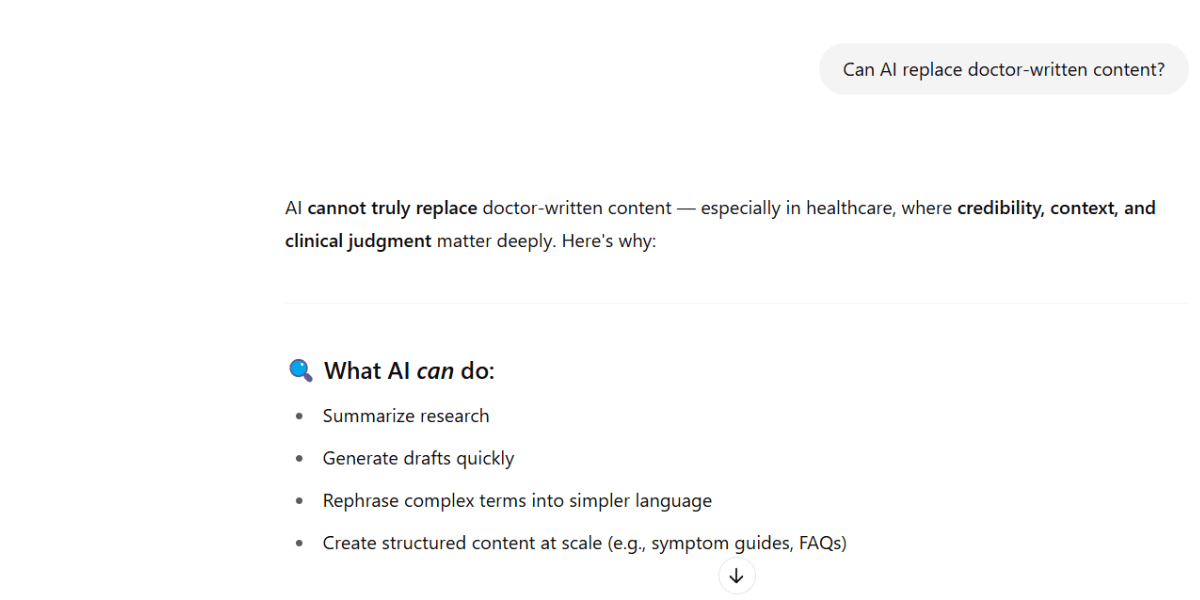
As expected, AI gave a perfectly well-balanced answer to AI vs doctor-written content.
We can’t deny that AI has begun to play a crucial role in medical diagnosis. However, regarding medical content writing, AI DOES NOT have the necessary skills, depth, and knowledge that a health professional has.
Agree that as soon as you give the command to AI, it promptly replies, but is such critical information credible?
The growing dependence on AI for medical writing thus raises this question: Can AI truly replace doctor-written content?
The answer is NO!
And there are good reasons why.
Why AI can’t replace doctor-written content?
Limitations of AI in medical writing
1. AI can’t imitate a Professional’s Medical Expertise
AI model uses the vast internet database, including medical journals, textbooks, clinical studies, medical blogs, etc., to generate the information you need. But who fed the internet with such vast knowledge?
Medical Content Writers or Doctors!!
Even if AI imitates the content, it cannot imitate the medical expertise used to collect those facts and figures.
On the flip side, doctors undergo rigorous studies, training, and clinical practice to develop their critical thinking abilities, ethical judgments, and practical experiences. Thus, they understand the complexities of the human body and its health conditions.
AI cannot understand such complexities and can only give a general viewpoint, whereas a doctor can bring tailored perspectives, accuracy, and empathy to the medical writing table.
For example, AI can tell you the side effects of chemotherapy, but only a doctor knows how one experiences those side effects emotionally and how they can be managed daily.
This in-depth and insightful knowledge enriches doctor-written content with case-based realities over and above textbook learning. Such writings resonate more with the patients looking for satisfactory guidance online.
2. Missing Trust in health information sources
The root of the relationship between a doctor and a patient is “TRUST”!
Patients searching for online information seek credible, authentic, and trustworthy content written under a doctor’s name. Even if the content is generated by AI, if it’s not critically reviewed and authenticated by a medical professional, it doesn’t carry any value. It needs to have references, disclosures, credentials, etc. that can be easily provided by a doctor. Such detailed articles ensure credibility in medical content and win patients’ trust.
3. Ethical concerns in AI medical writing
Medical content writing is not only about delivering information; it’s about responsible communication. Medical information shared online can have ethical implications, especially on sensitive topics such as mental health, terminal health conditions, reproductive diseases, genetic studies, etc.
When a doctor writes on such topics, he focuses on the language, tone, emotional impact, and the facts shared. AI lacks such an ethical compass and reproduces online general information that can overlook medical realities and risks.
4. AI can’t Supersede Ongoing Medical Adaptation
The medical field is ever-evolving, with the introduction of new diagnostics and technologies. Doctors stay updated with their continuing medical learning, clinical exposure, and collaborations.
AI lacks such active involvement with emerging guidelines. Of course, once the data is fed online, AI can be retrained periodically, yet it can’t apply this data meaningfully. Where expert-reviewed medical content utilises the latest research and can explain the what, why, and how, AI-generated content can have medical misinformation.
5. AI doesn’t concern itself with Regulatory Implications
You have copied and pasted AI-written medical content on your blog. What if this content doesn’t comply with medical regulatory standards, such as:
- AACI Healthcare
- FDA guidelines on health communication
- Health literacy benchmark
- HIPAA regulations for patient privacy
Misuse and misinterpretation of AI-generated information can lead to misdiagnosis, privacy breach, health harm, and even litigation. AI can’t adhere to the regulatory guidelines and standards that a doctor is well aware of.
Then, how to use AI?
AI can act as a supporting tool for medical writing by providing:
- Outlines for the blogs
- Organising information in a single space
- Brainstorming current topics
However, one needs a stamp of a professional medical writer to validate the information, review, edit, and synthesise a well-articulated ethical content.
What to Takeaway from this post?
“AI can NEVER replace Human Touch in Medical Writings”
That’s a fact, and we stand by it!
AI is remarkable, but it can never replace a doctor’s expertise and experience. It can assist, but can never supersede the expertise of a doctor in the realm of medical writing!
Healthcare content writing needs ethical responsibility, human empathy, and first-hand clinical knowledge, which AI alone can never replicate.
As doctors and medical content writers, we tailor the medical information specific to your health brand, blend it with scientific evidence, and enrich it with compassion to create content that educates, empowers, and builds trust with your readers.
Get in touch with us today for your healthcare content needs!
Share this article with your doctor friends who might be stuck between AI and doctor-written content.

- Why AI can’t replace Doctors in Medical Writing? - June 2, 2025
- 5 Steps to boost healthcare content marketing in 2023 - March 17, 2023
- Is ChatGPT the Future of Medical Writing? - February 18, 2023
Ohh this is a great article, i got an insight over this which is helpful for me in my ans writing not gonna. Thank you for such an amazing article Dr. Vinita
Thank you so much Shamama for your feedback
Thank you Shamama for your valuable feedback on the blogpost.
This is a thoughtful and well-articulated piece. You’ve highlighted an essential truth—while AI can support medical writing with speed and consistency, it lacks the clinical intuition, ethical judgment, and human empathy that doctors bring to the table. Your explanation about the importance of lived medical experience and nuanced decision-making really resonated. Thanks for shedding light on the irreplaceable role of medical professionals in shaping accurate, responsible content.
Thank you so much Mr. Firoz for your in-depth feedback on the blog post. I am glad you were able to relate to the content.
Certainly, I have been working with LLMs and potentially shortlisting usecases for AI implementation and Healthcare is one sector that we have brainstormed and I concur with the point that it can collaborate only and not create anything.
I am highly gratified that my blog post served as a real-life example in your case Mr. Santosh. Your feedback on this is very appreciated.
Absolutely correct AI can give u answer but a Dr will give you empathy which is a key factor
Thank you Deepak. Very well said.
Very valid points Dr. Vinita. AI is a helping agent in every field but it can never replace what a human can do especially in a case sensitive field like medicine.
Thank you Akshay for your valuable feedback.
Very valid points Dr. Vinita. AI is a helping agent in every field but it can never replace what a human can do especially in a case sensitive field like medicine.
I like how Dr. Vinita, has explained in a way that’s easy to understand. I agree that AI is a useful tool but can never replace Human experience/ expertise specially in medical field.
Thank you Ms. Aparna for your feedback.
Very well written and explained and undoubtedly AI is just a tool that can mimic human intelligence but it can never ever replace it, and definitely not a doctor. Doctor patient relationship is not something mechanical, it’s based on trust, transparency, open & honest communication, empathy and no technical tool can ever replace these key elem3nts.
Thanks for your feedback. Completely agree with your viewpoint
Absolutely true Dr. Jaishree. Thank you for taking out your valuable time and giving us a feedback.