

Yet another misconception about homoeopathy is that homoeopathic doctors oppose surgery.
Or you can use homoeopathy as an alternative to surgery.
As a practising homoeopathic physician with nearly eight years of experience, I want to clarify this today.
Homoeopathy is NOT against surgery. Nor does homoeopathy avoid surgery.
A responsible homoeopathic practitioner recommends surgery whenever it is medically necessary. At the same time, when surgical recommendations are avoidable, homoeopathy may help control symptoms, support healing, and in some cases prevent the need for surgery.
Read on for an elaborate.
But first….
Why Does This Myth Exist?
The belief that homoeopathy is against surgery developed over time due to:
- Early historical friction between modern medicine and homoeopathy
- Patients who improved with homoeopathy after being advised surgery
- Some practitioners discourage surgery more than the evidence supports
However, a responsible homoeopathic physician ALWAYS follows a safe, ethical, and patient-focused approach: homoeopathic treatment when appropriate, and surgery when the clinical condition demands it.
Conditions when surgery is mandatory
Homoeopathy cannot replace surgery in emergency or structurally irreversible conditions, such as: 🚑💥
🔥 Acute appendicitis with risk of rupture
🤕 Severe trauma
🪨 Obstruction due to kidney stones or gallstones
🩸 Severe internal bleeding
🎗️ Malignancies requiring surgical removal
🦠 Severe infections with sepsis
🚫 Intestinal obstruction
In such cases, delaying surgery can be dangerous. Ethical homoeopathic practice requires immediate referral to a surgeon.
However, there are other ways in which homoeopathy relates to surgery!
1. Preventing or Delaying Surgery in Selective Cases
There are many conditions in which homoeopathy may help avoid or delay surgery—provided the patient is stable, no emergency or life-threatening signs are present, and regular follow-up is maintained.
Examples of such conditions are:
-
Recurrent tonsillitis or adenoids
-
Uterine fibroids
-
Benign ovarian cysts
-
Small kidney stones (If a stone causes blockage, kidney damage, or fever, urgent treatment or surgery is needed)
-
Piles
-
Anal fissures
-
Nasal polyps
Here’s the USG report of a patient with a subserosal uterine fibroid. There’s a reduction in the size of the fibroid within 3 months of continuous homoeopathic treatment.
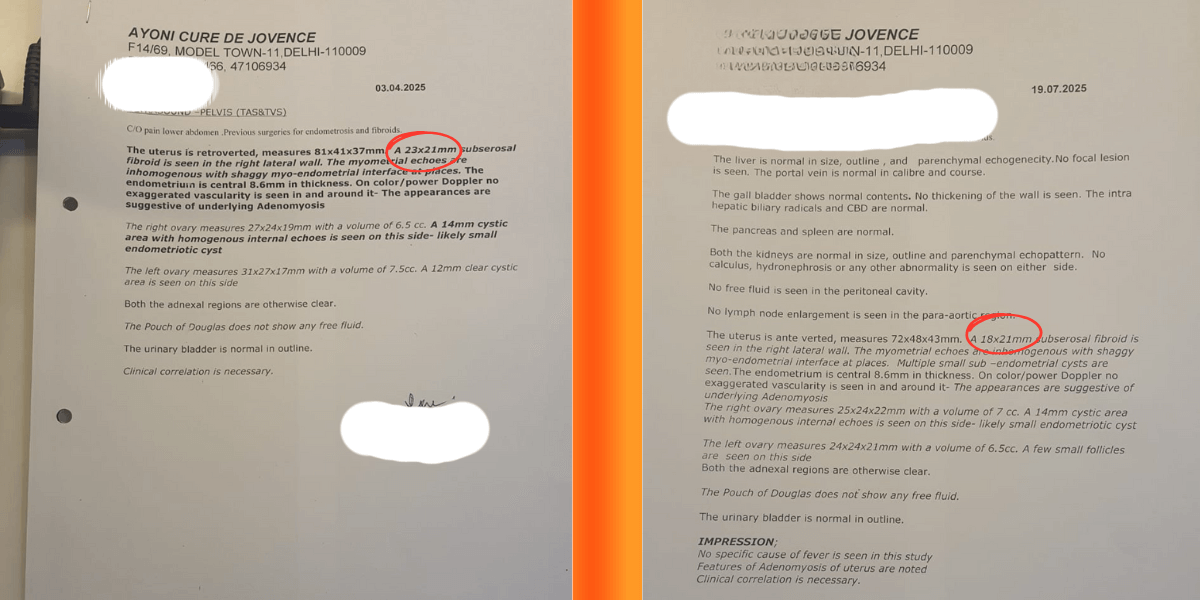
In such cases, homoeopathy can:
- Control or reduce symptoms
- Prevent disease progression
- Help resolve issues that might otherwise lead to surgery
2. Helping Patients Make Informed Decisions
Not all surgical recommendations are urgent. Some are elective.
In such cases, homoeopathic treatment:
- Offers time for second opinions
- Avoid invasive procedures for suitable patients
3. Supporting Post-Operative Recovery
Many patients use homoeopathy after surgery for:
- Reducing pain
- Lower swelling and inflammation
- Faster healing
- Better recovery and reduced complications
Homoeopathy and surgery, therefore, work as complementary approaches in such cases.
Safe and Ethical Approach to Avoiding Surgery
If a patient chooses to try homoeopathic treatment before surgery, a responsible practitioner should:
- Take baseline reports (blood tests, imaging, etc.)
- Explain the condition, prognosis, and all treatment options
- Clearly define emergency warning signs
- Set realistic review timelines
- Refer immediately if the patient worsens
Patient safety always comes first.
The balanced truth is:
FAQs
Are homoeopaths trained to identify surgical cases?
Yes, qualified homoeopaths learn to recognise when surgery is essential and refer promptly.
Can homoeopathy dissolve stones or fibroids?
Some patients may experience reduction or resolution, but results vary. Regular monitoring is essential.
Is it risky to delay surgery and try homoeopathy first?
It can be, if the case shows red flags, such as severe pain, fever, bleeding, obstruction, or risk of organ compromise. Homoeopathic treatment is safe only in stable, monitored cases.
Final Thoughts
Surgery and homoeopathy are not opposing systems. Each has its strengths:
- Homoeopathy offers safe, non-invasive management for many conditions
- Surgery provides life-saving and corrective solutions where structural damage or emergencies exist
When used together responsibly, patients receive the best of both worlds.
Have you ever been advised surgery and later avoided it with homoeopathy? Or do you feel homoeopathy should collaborate more with modern surgical care?
Share your thoughts, experiences, or questions in the comments — let’s clear myths together and make healthcare more transparent for everyone.

- Is Homoeopathy good for acute illnesses or only chronic ones? - December 16, 2025
- Does Homoeopathy Avoid Surgery? Myths Busted by a Doctor - December 10, 2025
- Are investigations required for homoeopathic treatment? - November 7, 2025